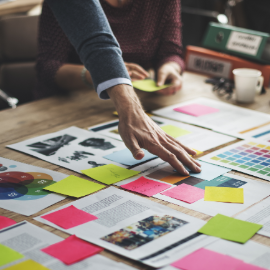
Design & Co-Creation

AI systems increasingly generate and act upon cultural outputs (language, images, narratives) yet often lack frameworks for interpreting the cultural complexity they encounter. As AI enters domains requiring contextual judgement rather than clear ground truth, traditional benchmarking breaks down. This research theme invites you to explore how participatory design, creative practice, and interpretive methodologies can shape AI systems that engage meaningfully with ambiguity, plurality, and diverse human values.
Current AI development risks homogenisation, where similar architectures trained on similar data reinforce narrow models of reasoning and representation. Your research could challenge this by investigating how to design AI systems that preserve multiple valid perspectives rather than producing monolithic outputs, how human-AI ensembles can enhance rather than replace human capabilities, or how communities can collaborate in building AI that serves their needs rather than having solutions imposed upon them.
Potential directions include developing interpretive evaluation frameworks that assess cultural nuance and contextual sensitivity, creating participatory methods that prevent ‘participation washing’ in AI development, exploring how generative AI transforms creative labour and agency, or designing human-AI collaboration patterns that amplify collective intelligence whilst preserving human autonomy. You might investigate how arts and humanities perspectives can inform AI architecture (not just interface design), how to ensure marginalised communities genuinely influence AI outcomes, or how to build systems where meaning is made collaboratively rather than dictated by algorithmic outputs.
This theme positions design, arts, humanities, and qualitative social sciences as integral to technical innovation. Whether your background is in design, computer science, creative arts, cultural studies, or social sciences, there are opportunities to contribute to AI that reflects the diversity, ambiguity, and richness of human experience rather than flattening it through narrow operational metrics.
Place-based and Regional Context
The North East offers distinctive opportunities for research in participatory AI design and creative industries innovation. The region’s creative sector contributes over £1.4 billion annually, with concentrations in screen industries, gaming, and digital media that provide real-world contexts for studying AI’s impact on creative work. Newcastle and Gateshead’s cultural quarter, including Baltic Centre for Contemporary Art and Sage Gateshead, offers partnerships for exploring AI in arts and cultural production.
Regional challenges around post-industrial transition, digital exclusion, and economic inequality create urgent needs for citizen-centred AI approaches. Projects could engage with Newcastle City Council’s digital transformation initiatives, collaborate with Tyne & Wear Archives & Museums on AI for cultural heritage, or work with creative organisations like Wubbleyou on participatory design for diverse communities. The region’s strong tradition of participatory design and community engagement, exemplified by Digital Civics work, provides methodological foundations for research that genuinely includes marginalised voices in shaping AI futures.
Relevant Partner Organisations
This theme connects with partners across creative industries, public sector innovation, and community organisations. Creative sector partners including Wubbleyou, Seymour-Powell, and Sunderland Software City offer contexts for studying AI in design practice and digital production. Public sector partners such as Newcastle City Council, Tyne & Wear Archives & Museums, and North of Tyne Combined Authority provide opportunities for participatory AI governance research.
Technology partners including Nokia Bell Labs, Google, and Thoughtworks bring expertise in AI development that can be combined with arts and humanities perspectives. Community organisations like VONNE and Innovation SuperNetwork enable engagement with diverse publics in co-designing AI systems. These partnerships support research spanning from creative AI tools to democratic governance, ensuring your work addresses real-world challenges whilst maintaining academic rigour.
 Google
 Innovation SuperNetwork
 Newcastle City Council
 Nokia Bell Labs
 North East Combined Authority
 North East Museums
 seymourpowell
 Sunderland Software City
 Thoughtworks
 VONNE
VONNE Wubbleyou
Related Reading
Foundational Vision
Doing AI Differently: Rethinking the Foundations of AI via the Humanities
2025. White Paper. The Alan Turing Institute.
Participatory AI Design
The Participatory Turn in AI Design: Theoretical Foundations and the Current State of Practice
2023. Proceedings of the 2023 ACM Conference on Equity and Access in Algorithms, Mechanisms, and Optimization. doi:10.1145/3617694.3623261
Reconfiguring Participatory Design to Resist AI Realism
2024. Participatory Design Conference 2024. doi:10.1145/3661455.3669867
Deliberating with AI: Improving Decision-Making for the Future through Participatory AI Design and Stakeholder Deliberation
2023. Proceedings of the ACM on Human-Computer Interaction, 7(CSCW1), 1-32. doi:10.1145/3579601
Generative AI and Design Practice
The Prompt Artists
2023. C&C '23. doi:10.1145/3591196.3593515
Generative AI and HCI at CHI 2024
2024. CHI EA '24. doi:10.1145/3613905.3636294
Value-Sensitive and Stakeholder-Centred Design
Human-AI Co-creation Frameworks
Designing Creative AI Partners with COFI: A Framework for Modelling Interaction in Human-AI Co-Creative Systems
2023. ACM Transactions on Computer-Human Interaction, 30(5), 1-28. doi:10.1145/3519026
The Co-Creative Design Framework for Hybrid Intelligence
2025. C&C '25.
Creative Industries and AI
Rethinking Creativity: Creative Industries, AI and Everyday Creativity
2022. Media, Culture & Society, 44(3), 601-612. doi:10.1177/01634437221077009
Artificial Intelligence in the Creative Industries: A Review
2022. Artificial Intelligence Review, 55(1), 589-656. doi:10.1007/s10462-021-10039-7
Creativity and Authorship
Establishing the Importance of Co-creation and Self-efficacy in Creative Collaboration with Artificial Intelligence
2024. Scientific Reports, 14, 18525. doi:10.1038/s41598-024-69423-2
Am I Still Creative? The Effect of Artificial Intelligence on Creative Self-Beliefs
2025. The Journal of Creative Behavior, 59(1). doi:10.1002/jocb.70011
Blurring the Lines: How AI is Redefining Artistic Ownership and Copyright
2023. Discover Artificial Intelligence, 3. doi:10.1007/s44163-023-00088-y
Artificial Intelligence and Creativity
2025. Philosophy Compass, 20(1). doi:10.1111/phc3.70030
Artificial Intelligence, Creativity, and Intentionality: The Need for a Paradigm Shift
2023. The Journal of Creative Behavior, 57(4). doi:10.1002/jocb.585
Public Sector and Civic AI
How Networks of Power Relations Shape Agency Decisions Around AI Design and Use
2024. Proceedings of the ACM on Human-Computer Interaction. doi:10.1145/3686989
Labour and Platform Economies
What Do Platforms Do? Understanding the Gig Economy
2020. Annual Review of Sociology, 46, 273-294. doi:10.1146/annurev-soc-121919-054857
Socio-technical Issues in the Platform-mediated Gig Economy: A Systematic Literature Review
2024. Journal of the Association for Information Science and Technology, 75(4). doi:10.1002/asi.24868
Cultural Work, Wellbeing, and AI
2024. Frontiers European Journal of Cultural Management and Policy. doi:10.3389/ejcmp.2024.12825
Cultural Policy and Governance
The Use of Artificial Intelligence in the Cultural and Creative Sectors
2020. European Parliament Policy Department for Structural and Cohesion Policies.
AI in the Cultural and Creative Industries
2024. UNESCO Germany.
The EU's Artificial Intelligence Act and Copyright
2025. Journal of World Intellectual Property, 28(1). doi:10.1111/jwip.12330
Copyright, Compensation, and Commons in the Music AI Industry
2021. Creative Industries Journal, 14(2), 190-207. doi:10.1080/17510694.2020.1839702
UK and European Policy
(2022-2025). Strategic Delivery Plan. UK Research and Innovation
Copyright and Artificial Intelligence
2024. GOV.UK consultation. doi:10.2139/ssrn.5154425
A Pro-innovation Approach to AI Regulation: Government Response
2023. GOV.UK.
Artificial Intelligence Act
2024. Regulation (EU) 2024/1689.
 CCAI Summer School 2026 is open for registration